

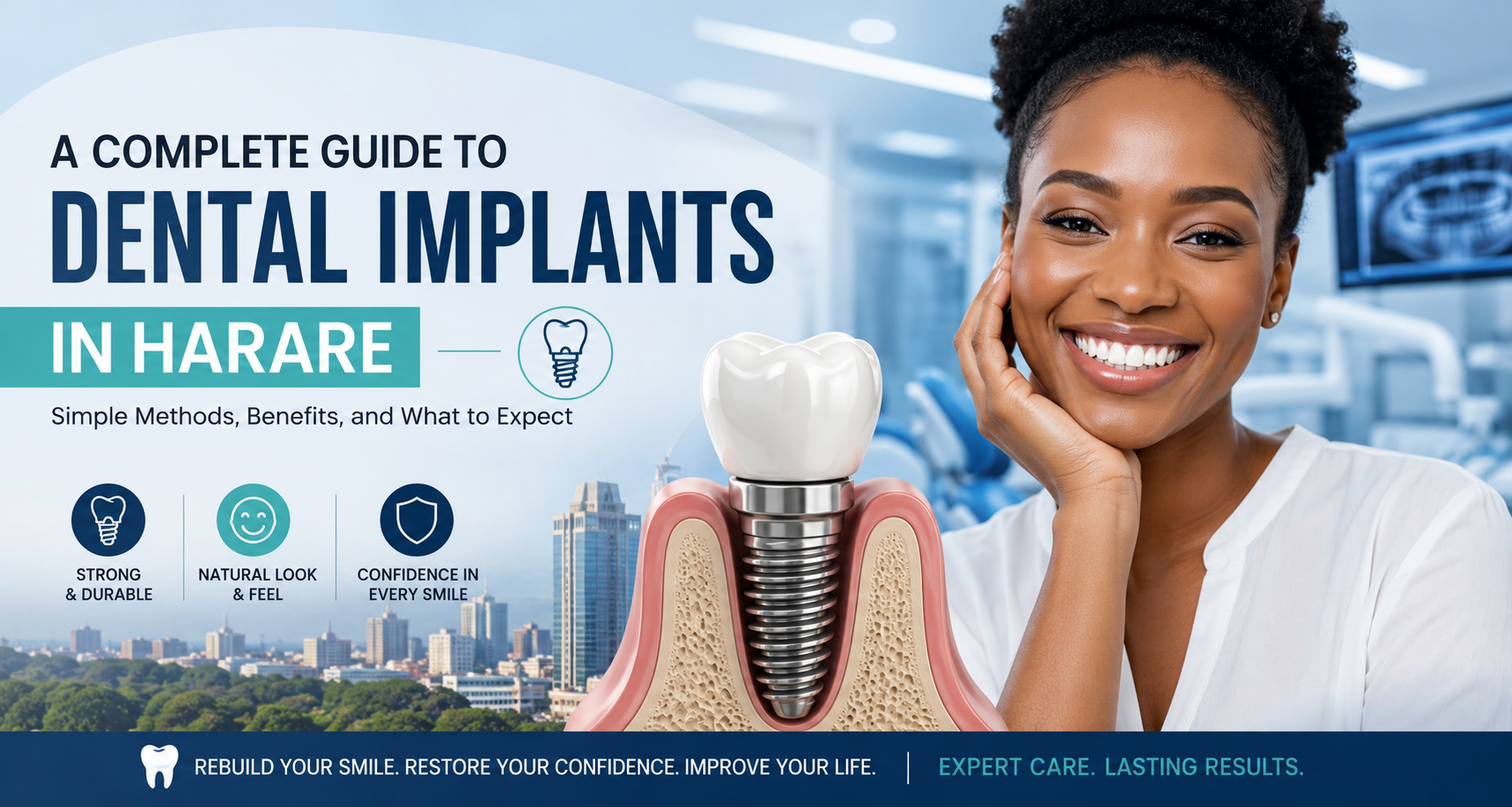
Losing a tooth can affect how you chew, speak, and feel about your smile. Fortunately, modern dentistry offers reliable ways to bring your smile back to life. For Harare residents looking for a permanent solution to missing teeth, dental implants have become the preferred choice over traditional removable dentures.
Here
is a straightforward, easy-to-understand guide to help you learn about dental
implants, how they work, and how to safely explore your options in Zimbabwe.
What
is a Dental Implant?
Think
of a dental implant as a tiny, high-tech replacement for your natural tooth
root. It is a small screw made of medical-grade metal (usually titanium) that a
dentist places into your jawbone.
Over
a few months, your natural jawbone heals and grips this screw tightly. Once
this bond is strong, the implant acts as a secure anchor. Your dentist then
attaches a custom-made crown (the visible tooth part) to the top. The result is
a replacement tooth that looks, feels, and functions exactly like a real one.
3
Simple Ways Implants Can Replace Missing Teeth
Different
people have different dental needs. Depending on how many teeth you are missing
and the health of your jaw, local dentists typically use one of these three
approaches:
1.
Replacing a Single Tooth (Implant and Crown)
If
you are only missing one tooth, this is the most common method. The dentist
places a single implant screw in the gap and tops it with a custom porcelain
crown. This method keeps your neighboring teeth perfectly intact because the
dentist does not need to grind down the healthy teeth next to the gap to
support a bridge.
2.
Replacing Multiple Teeth (Implant Bridge)
If
you have three or four missing teeth in a row, you do not need an implant for
every single gap. Instead, the dentist can place two implants on either side of
the gap and attach a durable dental bridge across them. This spans the gap
beautifully and securely.
3.
Securing Loose Dentures (Implant-Supported Dentures)
If
you have lost most or all of your teeth, traditional dentures can sometimes
slip, slide, or cause sore spots. To fix this, a dentist can place four to six
implants across your jaw. Your denture then clips securely onto these anchors.
This means you can eat, speak, and laugh with complete confidence, knowing your
teeth will stay firmly in place.
Quick
Comparison: Implants vs. Traditional Options
|
Option |
Stability |
Lifespan |
Impact on Nearby
Teeth |
|
Dental Implants |
Excellent (fixed into the bone) |
Designed to last 20 years to life |
None (stands completely on its own) |
|
Traditional Bridges |
Good (cemented in place) |
Usually lasts 10 to 15 years |
Requires grinding down adjacent
healthy teeth |
|
Standard Dentures |
Moderate (rests on the gums) |
Needs replacing or adjusting every 5 to 7 years |
Can put pressure on remaining teeth |
What
If Your Jawbone is Too Thin?
Because
implants rely on the bone for support, your jaw needs to have enough height and
thickness. If your tooth has been missing for a long time, the bone in that
area might have shrunk.
If
this is the case, your dentist might suggest a simple, supportive procedure
called bone building (or bone grafting). Using safe, specialized
material, the dentist can rebuild the thin areas of your jaw to create a solid,
stable foundation before placing the implant.
Safe
Dental Care: How to Choose a Dentist in Harare
When
looking into dental implants, your safety and health should always come first. Klarity
Medical Center is registered with the Medical and Dental Practitioners
Council of Zimbabwe (MDPCZ).
